
Head-On Collision Claims in Minnesota
A head-on crash leaves no room for a small injury. Two vehicles meeting front to front have no distance to shed speed, so the occupants absorb forces the vehicle was never built to manage. Under Minn. Stat. § 169.18, every driver must keep to the right half of the roadway. When a driver crosses that line, Andrade Law reconstructs how it happened, documents the full extent of the harm, and pursues every source of recovery available to you.
Free Consultation: No fees unless we win your case. Past results do not guarantee future outcomes. This information is for educational purposes only.
How Head-On Crashes Happen
A Driver Left Their Lane. The Question Is Why.
Head-on collisions in Minnesota follow a handful of patterns. On undivided two-lane highways, a vehicle drifts across the centerline. On divided freeways such as I-94, a driver enters an exit ramp and travels the wrong way. On rural stretches of US-10 or US-52, a driver passes in a no-passing zone and misjudges the gap. Each pattern points to a different set of evidence, and identifying the pattern early shapes the entire case.
The reason a driver crosses the line matters as much as the fact that they did. Drowsy drivers drift. Impaired drivers drift and overcorrect. Distracted drivers look up too late. In winter, a vehicle can slide across the centerline on black ice with the driver's hands never leaving the wheel. And a driver whose right tires drop off a soft shoulder often yanks the wheel back, overcorrects, and crosses into oncoming traffic in a single motion.
I've seen insurers describe every one of these as "an accident" in the neutral sense of the word. The evidence usually says otherwise. Phone records, event data recorders, toxicology, and the marks left on the pavement tell a specific story, and my job is to preserve that story before it disappears.
Crossover Patterns We Investigate
- Centerline drift on undivided two-lane highways
- Wrong-way entry onto a divided freeway or exit ramp
- Passing in a marked no-passing zone
- Drowsy, impaired, or distracted lane departure
- Ice or snow drift across the centerline
- Overcorrection after a shoulder drop-off
Crash Forces
Why the Injuries Are So Severe
Closing speed explains most of it. Two vehicles traveling toward each other at 55 miles per hour close the gap at 110 miles per hour. That does not mean each car experiences a 110-mile-per-hour wall strike. For two vehicles of similar mass, each one absorbs roughly what it would absorb striking a rigid barrier at its own speed. The problem is that the gap closes in a fraction of a second. There's no room to brake, no room to steer, and no time for the body to prepare.
The front structure of a modern vehicle is designed to crumple and absorb energy. In a head-on impact, that crumple zone collapses into the footwell. Feet, ankles, and lower legs are crushed or pinned. The femur and pelvis take the load of the body sliding forward against the seat belt. The chest meets the steering column or the airbag at speed, which can fracture ribs, bruise the heart, or tear the aorta. The head decelerates against the restraint, and the brain keeps moving inside the skull.
These are the injuries I see in head-on files: bilateral leg fractures, hip and pelvic fractures, internal bleeding, spinal fractures, and moderate to severe traumatic brain injury. Some occupants don't survive the scene. When they do, recovery is measured in surgeries and months, and the medical record needs to be built for the long term through catastrophic and life-altering injury claims, not for a quick settlement.
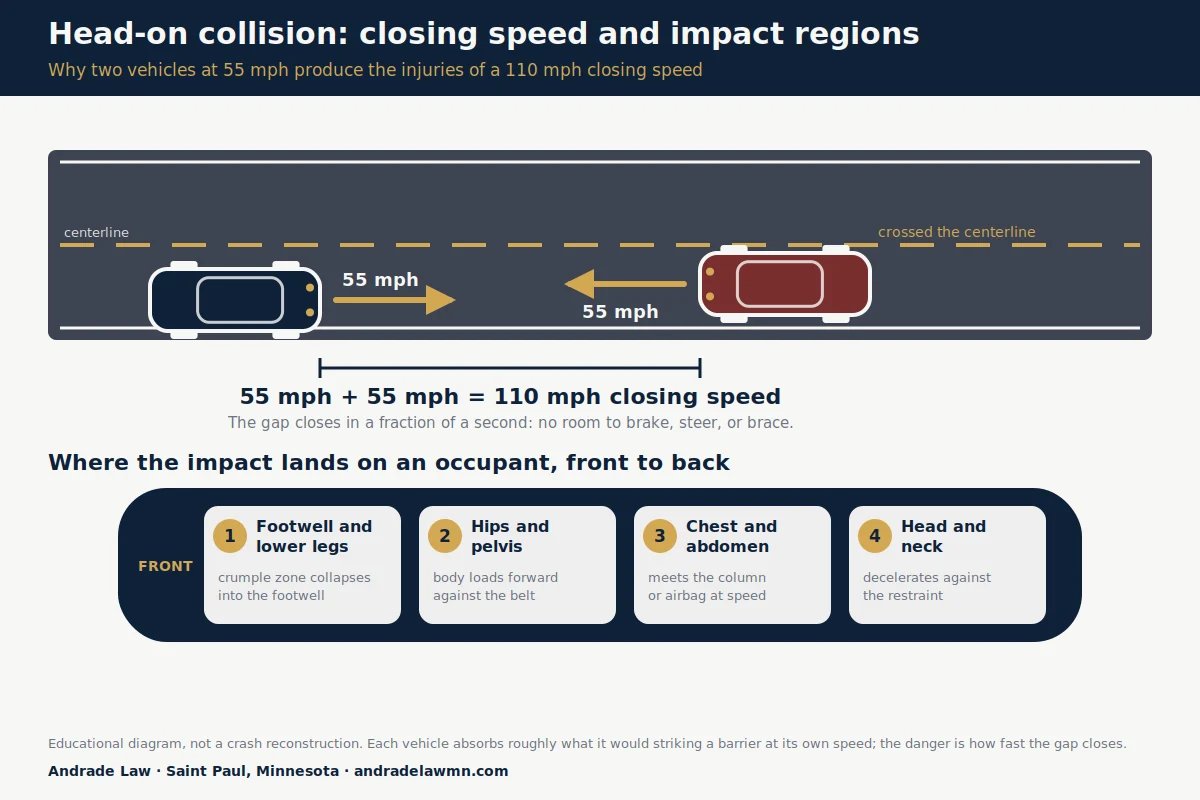
| Impact Region | Typical Head-On Injury | What the Record Must Capture |
|---|---|---|
| Footwell and lower legs | Crushed feet and ankles, tibia and fibula fractures, pinned extremities | Extrication report, surgical notes, weight-bearing restrictions, mobility prognosis |
| Hips and pelvis | Femur fractures, acetabular and pelvic ring fractures | Hardware placed, future revision surgery, long-term gait limitations |
| Chest and abdomen | Rib fractures, cardiac contusion, aortic injury, organ lacerations | Trauma bay imaging, ICU course, cardiothoracic follow-up |
| Head and neck | Concussion through severe traumatic brain injury, cervical fractures | Loss-of-consciousness documentation, neuropsychological testing, imaging sequence |
Brain injuries in head-on crashes deserve their own attention. Symptoms can be masked in the trauma bay by more obvious orthopedic injuries, and the cognitive effects often surface weeks later at home or at work. The path for those cases runs through traumatic brain injury litigation claims, where the medical proof is built differently.
Liability
Fault in a Head-On Collision Under Minnesota Law
A driver who leaves the right half of the roadway and strikes oncoming traffic starts the case at a disadvantage. Minn. Stat. § 169.18, subd. 1 requires vehicles to be driven on the right half of the roadway, with narrow exceptions for lawful passing and obstructions. Minn. Stat. § 169.18, subd. 5 restricts driving to the left of the centerline in no-passing zones and where the view ahead is obstructed. A driver in the wrong lane has, on the face of it, violated a safety statute, and that presumption of negligence is where I begin.
The presumption is rebuttable. The at-fault driver's insurer will argue sudden emergency, meaning an unexpected hazard forced the lane departure. They'll argue mechanical failure, such as a tire blowout or a steering defect. They'll argue that an unmaintained road, an unplowed curve, or a missing shoulder caused the loss of control. Sometimes they'll argue a phantom vehicle forced their driver over and then drove away. Each of these defenses can be tested against physical evidence, and most of them fail when the reconstruction is done properly. Speed matters here too. Minn. Stat. § 169.14 requires a speed that is reasonable for the conditions, and a driver who was traveling too fast for a wet or icy curve cannot hide behind the weather.
Minnesota applies modified comparative fault under Minn. Stat. § 604.01. You recover as long as your share of fault does not exceed 50%. At exactly 50%, you can still recover, with your damages reduced by that share. Insurers in head-on cases sometimes argue that the injured driver could have swerved or braked sooner. With a closing speed above 100 miles per hour, that argument usually collapses under the reaction-time math. The framework for how fault is allocated across all motor vehicle collision litigation is covered on the parent service page.
When the crossover driver was impaired: A driver who crosses the centerline while over the legal limit has violated Minn. Stat. § 169A.20 on top of the lane-position statutes. Minnesota permits a claim for punitive damages, added by motion under Minn. Stat. § 549.191 once the evidence supports it. Those cases are handled through drunk driving crash injury claims, where the toxicology and the bar-or-restaurant evidence are gathered on their own timeline.
Insurance and Damages
No-Fault Benefits, the Tort Threshold, and Uninsured Drivers
Minnesota is a no-fault state. Your own policy's PIP coverage pays initial medical expenses and wage loss under Minn. Stat. § 65B.44, regardless of who crossed the centerline. Those benefits are limited, and in a head-on crash they are typically exhausted within the first hospital stay. Disputes over what PIP owes are handled through no-fault insurance and PIP dispute claims.
To pursue the at-fault driver for the full measure of your loss, your injuries must meet the tort threshold in Minn. Stat. § 65B.51: permanent injury, permanent disfigurement, disability for 60 days or more, or medical expenses above $4,000. A head-on collision clears that threshold almost by definition. The dispute in these cases is rarely about whether you can sue. It's about how much the claim is worth and who will pay it.
That second question is the one people don't expect. A driver who crosses the centerline drunk at 2 a.m. often carries the state minimum liability limits under Minn. Stat. § 65B.49, which are $25,000 per person and $50,000 per crash, or carries no insurance at all. Those limits don't cover a single night in a trauma unit. Your own uninsured and underinsured motorist coverage becomes the primary source of recovery, and your own insurer becomes the adversary. I handle that stage through uninsured and underinsured motorist claims, including the stacking and coverage disputes that follow.
Economic Damages
- Trauma care, surgeries, and hospital stays
- Rehabilitation, prosthetics, and mobility equipment
- Future medical care over a lifetime
- Lost wages and lost earning capacity
Non-Economic Damages
- Physical pain and permanent limitation
- Disfigurement and loss of function
- Loss of enjoyment of life
- Effects on spouse, children, and household
For catastrophic injuries, the largest number in the case is usually future care. Home modifications, attendant care, and replacement surgeries decades out have to be priced now, because there is no reopening a settled claim. Our catastrophic injury lifecare cost calculator shows how those categories add up before an economist formalizes them.
Case Building
How I Build a Head-On Collision Case
Head-on cases are won on lane position. The insurer's defenses all come down to one claim: their driver didn't cross the line, or crossed it for a reason nobody could control. Gabriel E. Andrade (MN Bar #0402606) answers that claim with physical evidence, in four stages:
Scene and Lane-Position Evidence
The pavement records where the impact happened. Gouge marks show the point of maximum engagement. The debris field and fluid spill fan out from that point in the direction of travel. Final rest positions and tire marks show who was where at impact. We photograph and measure all of it before weather and traffic erase it, and we request state patrol reconstruction files, 911 audio, and any camera footage from the corridor. In Saint Paul and the surrounding metro, intersection and business cameras often capture the seconds before impact, and that footage is overwritten within days.
Black-Box and Digital Evidence
Both vehicles' event data recorders store the last seconds before impact: speed, throttle, braking, and steering input. That data settles the swerve-and-brake arguments, and it is lost the moment a vehicle is crushed or sold for salvage. I send a vehicle telematics and black-box preservation letter to every carrier and storage lot immediately. Phone records, toxicology from the hospital draw, and any commercial telematics on a work vehicle follow the same preservation track.
Reconstruction and Medical Causation
I retain an accident reconstructionist to combine the scene measurements, the recorder data, and the crush profiles of both vehicles into a single account of the collision. That account is then matched to the medical record so each injury is tied to a specific force. Treating surgeons document mechanism of injury, and where the defense will dispute permanency, we obtain the imaging and treating-physician opinions early rather than at trial.
Life-Care Planning, Demand, and Resolution
For serious injuries, a life-care planner and an economist price the decades of care ahead. Every policy that could respond is identified: the crossover driver's liability coverage, any employer or vehicle-owner coverage, and your own underinsured motorist coverage. The demand package presents liability, damages, and coverage together. If the carriers won't resolve the claim fairly, we file in Ramsey County District Court and prepare it for trial.
Fatal Collisions
When a Head-On Crash Takes a Life
Some head-on collisions are not survivable. When a family loses someone this way, the claim belongs to the next of kin and is brought by a court-appointed trustee under Minn. Stat. § 573.02. The evidence work is the same as in an injury case, and it has to move faster, because the person who could describe what happened is gone and the physical record is all that remains.
I handle these cases with the care they demand. The family's job is to grieve. Mine is to preserve the vehicles, secure the recorder data, and identify every source of recovery so that the financial consequences of the crash don't compound the loss. The full process is described under wrongful death and fatal injury litigation.
Head-on collisions involving a semi-trailer or other commercial vehicle raise the same catastrophic-injury issues on a larger scale, and the trucking carrier's own investigators are on scene within hours. Those cases overlap with truck underride crash and catastrophic injury claims, where federal preservation rules and carrier insurance layers change the approach.
Deadlines
Filing Deadlines for Head-On Collision Claims
Minnesota's statute of limitations controls how long you have to file suit. Miss the window and the claim is barred no matter how clear the lane-position evidence is. For head-on collision injuries, these are the windows that apply:
| Deadline | Claim Type | Citation |
|---|---|---|
| Personal injury from a motor vehicle collision | Minn. Stat. § 541.05 | |
| 180 days | Notice of a claim against the State of Minnesota (for example, a state-maintained roadway) | Minn. Stat. § 3.736 |
Six years sounds generous. In a head-on case it isn't. The vehicles are the evidence, and salvage yards crush them within weeks. Recorder data, camera footage, and witness memory decay on the same schedule. The legal deadline is the outer limit, not the plan.
Deadlines for fatal crashes, claims involving minors, and claims against cities or counties follow their own rules. The full breakdown is in our guide to Minnesota injury claim filing deadlines.
Frequently Asked Questions
Head-On Collision Claims: Questions and Answers
The other driver crossed the centerline. Isn't fault automatic?+
Close, but not automatic. Driving left of center violates Minn. Stat. § 169.18, and that creates a strong presumption of negligence. The other driver's insurer can still argue a sudden emergency, a mechanical failure, or a road condition forced the crossover. Those defenses are answered with the physical evidence, which is why preserving the vehicles and the scene data early matters so much.
The driver who hit me had minimum insurance. Where does the rest of the money come from?+
From your own underinsured motorist coverage, from any other policy covering the at-fault driver or their vehicle, and in some cases from a bar or employer whose conduct contributed. Minnesota minimum limits are $25,000 per person under Minn. Stat. § 65B.49, which a head-on injury exceeds quickly. Identifying every responding policy is one of the first things we do.
The other driver died in the crash. Can I still bring a claim?+
Yes. Your claim proceeds against the deceased driver's insurance policy and, where necessary, their estate. The evidence work is unchanged. If anything, the recorder data and reconstruction become more important because the other driver cannot give a statement.
I don't remember the crash. Does that hurt my case?+
Memory loss after a head-on crash is common and often a sign of a brain injury that needs to be documented. It doesn't hurt the liability case. Lane position is proven by physical evidence, recorder data, and witnesses, not by your recollection. Tell your treating providers about the gap so it becomes part of the medical record.
The insurer says I could have swerved. Does that reduce what I recover?+
Only if a jury agrees, and only by your percentage of fault under Minn. Stat. § 604.01. At a closing speed above 100 miles per hour, the time between seeing a vehicle cross the line and impact is often shorter than a normal human reaction time. Reconstruction usually shows there was no avoiding maneuver available, and the argument fails.
After the Crash
What to Preserve After a Head-On Collision
Most people injured in a head-on crash leave the scene by ambulance and can't gather anything themselves. That's expected. A family member or friend can take these steps in the days that follow. For the printable version, use our post-accident documentation checklists.
- ✓ Find out where both vehicles were towed and ask that they not be released or crushed
- ✓ Get the state patrol or police report number
- ✓ Write down the names of any witnesses who stopped
- ✓ Keep every discharge summary, imaging report, and bill
- ✓ Note any memory gap, headache, or confusion and report it to the treating team
- ✓ Do not give a recorded statement to the other driver's insurer
- ✓ Locate your own auto policy so the UM/UIM limits can be confirmed
Head-On Crash Injuries Change Lives. The Recovery Should Match.
If a driver crossed the line into you or someone you love, the evidence that proves it is disappearing now. Contact Andrade Law for a free case review. No fees unless we recover compensation for you.
This page is general information, not legal advice. Every case depends on its facts. Past results do not guarantee future outcomes.
Your Attorney
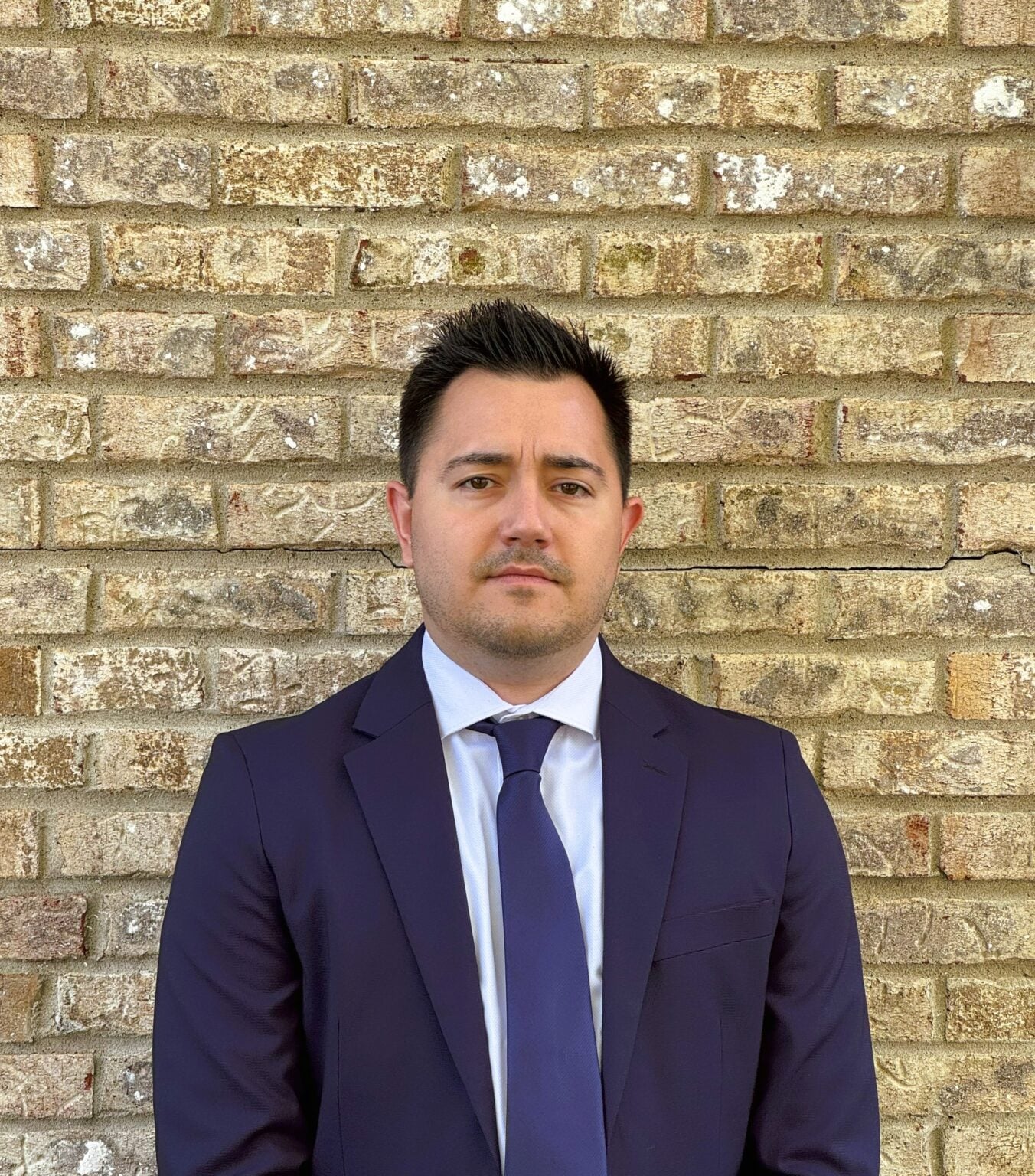
Gabe Andrade
Minnesota Personal Injury Attorney
Gabriel E. Andrade handles head-on collision cases across Minnesota. These crashes carry the most severe injuries — we investigate lane-crossing evidence, black-box vehicle data, and driver impairment patterns to build the clearest liability picture possible.
Professional Associations